A blast from the past I: The road to a PhD in Astrophysics
Over a decade ago, I started a blog about my PhD journey. That blog is now discontinued, but I wrote some content for it that I think still stands the test of time and deserves to be revisited. The original text was written in Norwegian.
The text below was originally published on September 15th, 2014, and was about the road I had taken to start a PhD in astrophysics, and about my research and scientific outreach work. The target audience was bachelor students who had not decided on what to major in.
Look out for 💬 boxes where I add some present-day comments to the old text.
The road to my PhD
I started with a Bachelor's degree from the University of Oslo in Physics, Astronomy and Meteorology, specializing in astronomy. During my bachelor's, I spent one semester at the University of Minnesota, an experience I found extremely valuable, and one I'd encourage anyone studying in Norway to have (not specifically at UMN, but a semester abroad in general).
After my bachelor's, I went straight into a Master's degree in astronomy at the Institute of Theoretical Astrophysics, the university's smallest institute and one of its most productive! There I worked with a British supervisor on a very theoretical thesis with the juicy title "Cosmological Dynamics, Statistics and Numerical Techniques of f(R) Gravity." Unfortunately, I didn't have time to go abroad during my master's, even though that was something I'd originally wanted to do, so for those of you planning a Bachelor's plus Master's and thinking of doing your semester abroad during the Master's, I'd recommend doing it during the Bachelor's instead. The logistics are a lot simpler that way.
When I started my master's, I had no plans to do a PhD, but it turned out research was incredibly fun, and when the opportunity presented itself, I couldn't say no.
Crash course in "Computational" Astrophysics
So I'm currently a PhD candidate in astrophysics, more specifically, I work on "Computational Astrophysics." Even more specifically, I work on "implementing hydrodynamic effects in N-body simulations of galaxy clusters with modified gravity laws." Now, what does that sentence even mean? Well, I'll be telling you a lot more about that in the time ahead, but for now, let's do a quick crash course.
When we observe the universe on a very large scale (where galaxies are just tiny dots) we see that there is a "structure" to the universe.
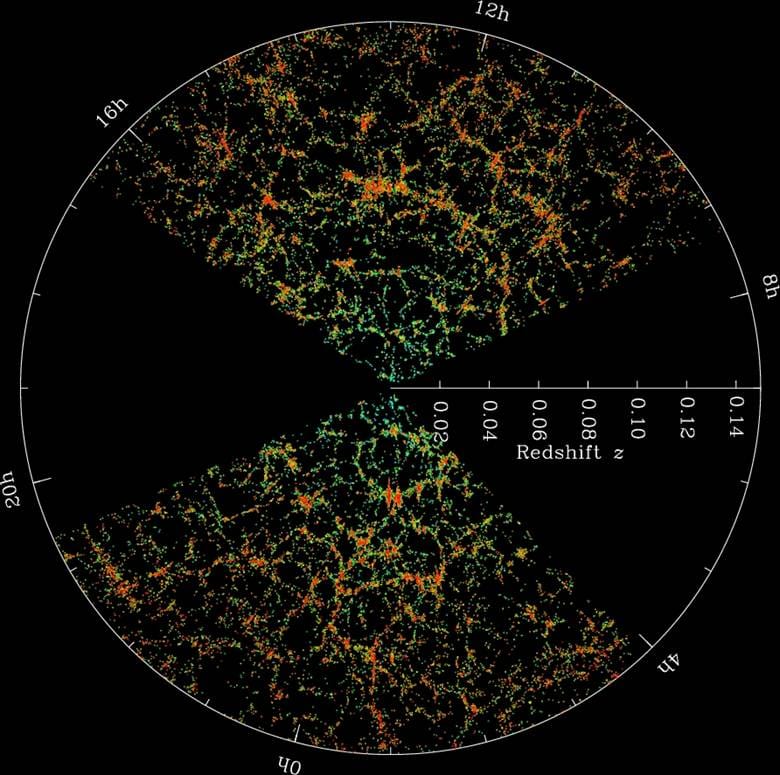
The goal of cosmologists (a subset of astrophysicists) is to use the laws of nature as we know them to simulate galaxies and see whether similar structures emerge in the simulations. This is usually done with a fair number of assumptions and simplifications, among them that the universe consists only of "dark matter" (matter that is only affected by gravity). Doing this, we can get very good results:
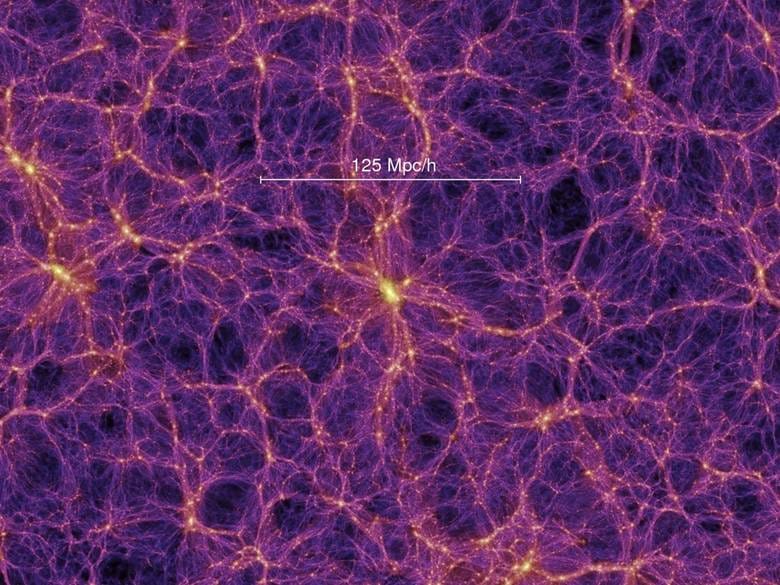
Even though it looks to the naked eye as if cosmologists have managed to reproduce structures similar to what we observe, statistical analysis shows the simulations aren't quite right. One possible solution to this is that maybe Einstein's general theory of relativity (the law of gravity we currently believe in) isn't entirely correct, and so Modified Gravity cosmologists try running these simulations with alternative gravity theories to see if they can simulate reality better than Einstein.
But here's where we run into a massive problem. All these simulations use only "dark matter," meaning the simulations contain nothing of what we see around us: no stars, no atoms, nothing! We try to fix this by adding a simple "gas" into these simulations to represent the stars and atoms in the universe (on a large scale, galaxies, stars, and planets move like particles in a gas, so this simplification is actually a really good one), and then we see how this changes the results.
Science Outreach
I'm currently taking a course at UiO called MNKOM9000 - Science Communication, where I'm hoping to learn more about how to communicate research as effectively as possible. The first step in that process, naturally, is to start a blog.
While doing my PhD, I've noticed that researchers pay far too little attention to getting knowledge out to ordinary people in an understandable way, while at the same time chuckling over their coffee cups when they read in the newspaper about how "stupid" ordinary people are and how wrong they get things (the hysteria around the CERN start a while back is a good example). That's not how I want the world to be, and if I can't change the behaviour of other researchers, I can at least do something myself.
Last semester I was on NRK's science program Ekko, as a member of the expert panel of Abels Tårn, and helped answer questions for a couple of articles on NRK Viten.
Even though I felt these attempts of mine at science communication went well, I've never actually had any training in it (my opinion on just how badly UiO's degree programs fail at teaching communication skills in general is a topic for another day), and I wished there was a PhD-level version of the MNKOM courses... And right after I started doing outreach work, MNKOM9000 was launched, right on cue.
Let me wrap up this post before it gets too long, with one sentence summing up my philosophy on science communication: "Communicating science in an understandable way to the public is just as important as the research itself. If tomorrow's leaders don't know what we're actually doing, what good is our research?"
The blog post wasn't that long.... Anyway, I think it was an okay post. And my sentiment at the end rings true even more today, where anti-science politicians get more and more power and cognitive capabilities are declining in younger generations. Scientists need to step up their game and care about sharing their knowledge.