ER subverted my expectations

Earlier this year, I got hooked on The Pitt. An amazing medical drama taking place all in one day in a busy emergency room in Pittsburgh, with each episode representing one hour of the day. I enjoyed it so much that I had to show it to my wife, and soon we had devoured all available episodes, and the wait for the third season felt like an eternity. Luckily, there was something else that could scratch the Pitt itch while we waited: ER.
The Pitt is, in fact, a spiritual successor to ER. Both shows star Noah Wyle as an experienced ER attending. The show was initially pitched as a direct spin-off of ER centered around Wyle's John Carter, but they ran into problems securing the rights from the Crichton estate. The idea was too good to abandon, though, so names were changed, the story slightly altered, and John Carter became Michael Robinavitch.
We were slightly hesitant, worried the show might feel dated, belonging to a long-gone era of television, but we stayed optimistic. It didn't take long before it was clear that ER lived up to its reputation as a great TV show and definitely scratched the Pitt itch. It was fun to relive the 90s through a show that was so grounded and current. I had forgotten how HIV/AIDS was a looming threat to everyone back then. And the absence of mobile phones and social media makes you want to go back and live in a simpler time.
Still, even though it's certainly a great show, you can often see where the plot will go. "I bet their relationship will end," "I think she's going to die now," "they will for sure get together soon," and so on. We're not always right in our assumptions, but we've got a pretty good track record. Then, at the beginning of the third season, ER subverted my expectations better than a lot of other movies and shows have done in a long time.
It was not a surprise twist of Shyamalan magnitudes, the kind you can rarely see coming, but at the same time those never really subvert my expectations either. We watch the Sixth Sense feeling something is off from the beginning, so when the shoe drops, we are surprised, but no expectations are subverted. But in ER, Mark Green and Susan Lewis are best friends. They've both become single and spend more and more time together. Finally, they share a kiss and realize their true feelings for each other.
Then Susan decides to leave Chicago. She's moving to Arizona to be with her niece/adoptive daughter and her sister, to help them build a new life. Mark Green realizes he cannot allow this to happen. He chases her down at the train station, fighting the clock as departure time nears, and in true cinematic fashion arrives just as she's boarding the train. He tells her that he loves her. He asks her to stay.
My wife is a romantic, which means I've seen dozens of romance movies over the years, from classics with Hepburn from the 50s to current ones with Heigl or whoever is doing those today. They're not quite my cup of tea, but I've enjoyed my fair share of them. They are, however, very predictable and all seem to have a rather superficial view of love.
Love is not easy to grasp, because what love is differs for every person. Myself, I didn't truly believe love was even a thing until I met my wife, and even more so when we had our daughters. Now I believe love is something much more than chemical signals in our brain telling us to breed and raise our offspring. Something intangible, but also paramount to the human existence. But when it comes to romance movies, love trumps all. The declaration of love works. The person confesses that they too love them, and gets off the train, or the plane, or backs out of the wedding they were about to enter into with the wrong person, and the story resolves itself as one of them rearranges their entire life to accommodate love.
Susan responds and tells Mark that she loves him too and has the same desires he does, but then proceeds to say that it is not enough, and gets on the train anyway. This was not a rejection of the proclamation itself. That sometimes happens in other movies too. She doesn't tell him he's wrong, or that he's too late. She just tells him that her life is already moving somewhere else, and that loving him doesn't change where it's heading.
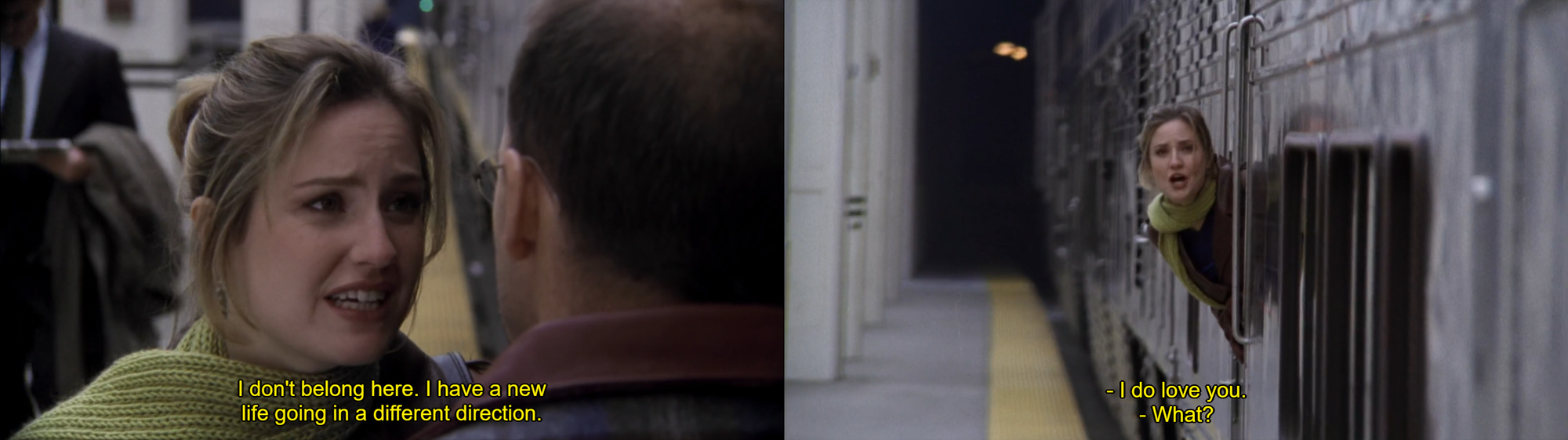
ER surprised me because rarely have I seen love portrayed alongside the realities of life before. Susan has her reasons for leaving that have nothing to do with Mark: family, her own happiness, a new beginning. When she gets on that train, she's giving up the chance of love with Mark, but she's also pursuing a decision she's been gradually working towards for weeks and months. Love is important, but sometimes it's too inconvenient for life. It's not as romantic as watching Katherine Heigl throw her job away to travel with her true love, but it's realistic and grounded. And I'm happy to see ER keeping even its romantic subplots grounded.
-- Amir