Hitman: World of Assassination — Assassinating My Hours, One by One
Sometimes I find it hard to find the time to sit down and write. I have a full-time job, two kids who combined have four after-school activities, and I am the one who cooks in our household. On top of wading through the query trenches, writing to agents and refining my first novel, I write my next novel and am also trying to keep up with this blog. I also watch the occasional movie, a TV show here and there, and game frequently. At least I am not a big fan of gigantic time-sink games, as I prefer shorter, story-focused or puzzle-focused games. I couldn't imagine spending hundreds upon hundreds of hours in a single game.
Hmm, what’s that? I have 1400 hours in Hitman: World of Assassination? Nono, I just play it now and then. Surely that must be wrong. Hmm, carry the one. Huh, seems the numbers are accurate. Well then, how did that happen?
At university, a full-time academic year typically involves about 300 to 450 hours of direct classroom instruction. However, when you factor in required self-study, reading, and assignments, universities generally expect a total workload of 1,200 to 1,500 hours per year. Which means I spent the equivalent of a whole year at university in one game… and I did not even notice.
Now, Hitman is a fantastic game, one of my all-time favourites. It mixes the thrill of social stealth with creativity as you figure out the best way to take out your targets with none the wiser, and the excitement of salvaging the situation when something goes awry is just exquisite. But still, this is a lot of hours spent sneaking around, arranging accidents to kill hundreds of targets on two dozen maps. What keeps this from becoming repetitive and boring?
Every game is built on what we call a gameplay loop, where you are faced with a challenge, perform an action to overcome it, and receive a reward for succeeding. A well-crafted gameplay loop is effective because our brain releases dopamine when we receive a reward, motivating us to repeat the process over and over again. Developers have found sinister ways of monetizing this, turning games into "Skinner boxes" where unpredictable rewards compel players to continue playing long after they are no longer finding the gameplay fun. They need to continue playing to open one more chest, even if they don’t want to.
But Hitman is not that kind of game, and it does not ask me to spend any more money as I play it. The first part of Hitman WOA came out in 2016, and IO Interactive has continuously released additional content for free. There have been regular roadmaps of new challenges, featured contracts, seasonal events, and a new mission starring Milla Jovovich as an elusive target released as late as February 2026, with a new section to an existing map, a new story, a unique virus mechanic, and dozens of new dialogue lines. They even added a full roguelite mode, Freelancer, in 2023.
Hitman is a sandbox of overlapping systems, guard routines, disguises, hidden routes, dozens of small "opportunities" scattered through every level. The people who design it have openly said they want players to misuse those systems in ways nobody anticipated. IOI's creative director described a session of Hitman as a multiplayer match you happen to be playing alone, because the same five minutes of in-game time plays out completely differently depending on what you are wearing, what you brought with you and a cascade of possible ramifications of what you did five minutes earlier.
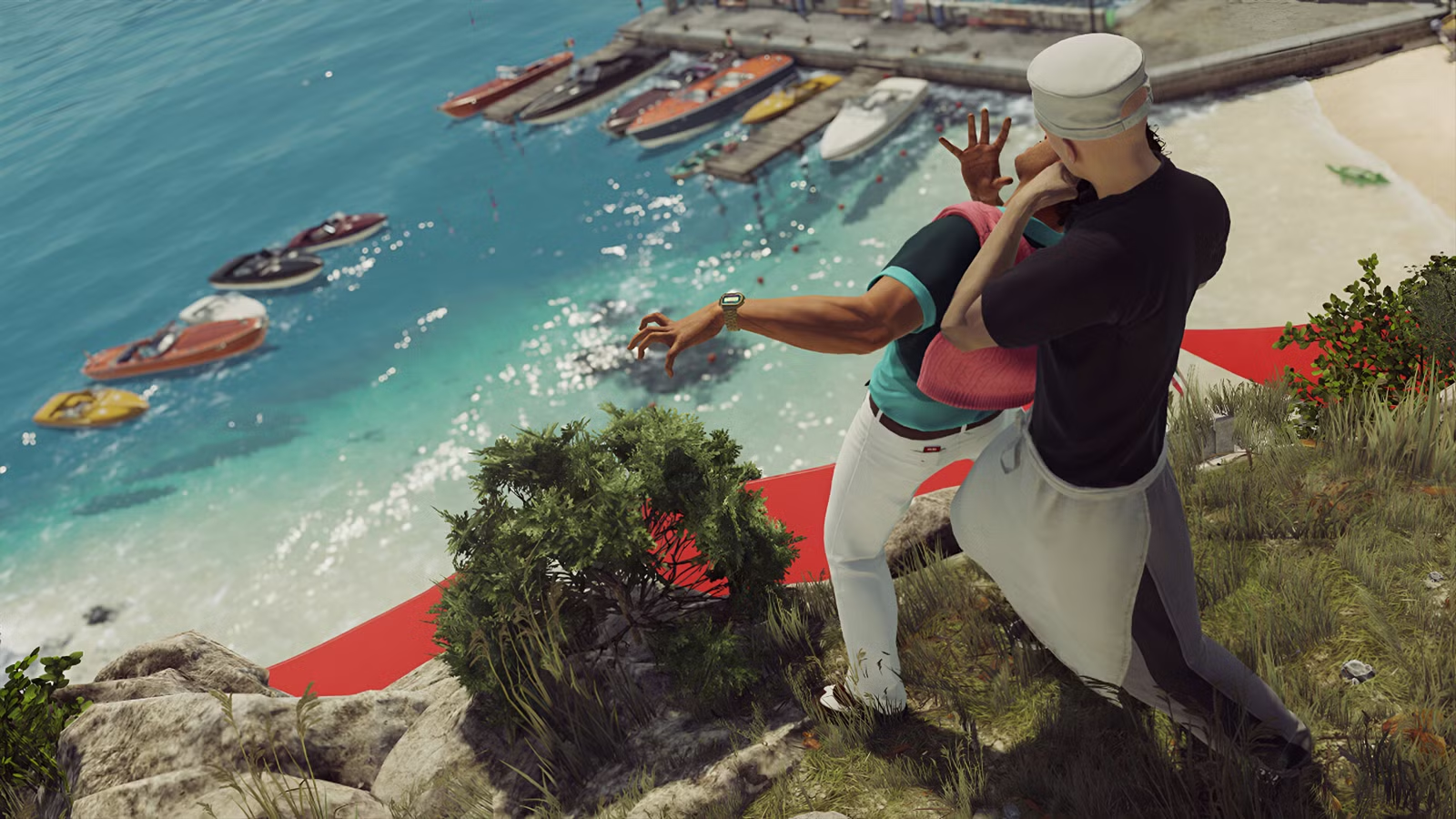
This leads to moments of brilliantly absurd mischief. For instance, you might knock out a guy named Rocco on his first day as a cook, steal his uniform to infiltrate a mansion kitchen, and use a can of expired spaghetti sauce to make your target, Caruso, sick. The target isolates himself to empty his stomach on the cliffside, leaving him perfectly vulnerable. It is incredibly fun, and that sequence is just one of a hundred completely different ways to deal with that single target.
But that alone does not explain the fourteen hundred hours. The real hook for me is something simpler. I am what is called a completionist: a gamer who strives to reach 100% completion in a video game by finishing every possible quest, finding all collectibles, and unlocking every achievement.
However, I am not the kind of completionist in every game I play. Hunting down a hundred hidden collectibles in a sprawling open world does absolutely nothing for me. There has to be a little extra something to keep me coming back, and Hitman has it.
They keep adding Challenges. No matter how small the challenge is, I like to return to the game and finish them off. Hitman offers a wide range of these, usually in the form of adding additional conditions to complete the missions, giving hundreds of reasons to give the game another go. These challenges are not just busywork. They fundamentally change the puzzle. The hardest of them all is called Silent Assassin, Suit Only: finish the mission, kill only the targets, let no bodies be found, never get spotted, and never change out of your starting suit.
That is the little extra. A challenge in Hitman forces you to relearn a map you already thought you mastered. Sometimes it is something small, other times it is major and I have to scratch my head to figure out how to get it done.
The reason why I have managed to spend fourteen hundred hours in this one game is that it is just the perfect blend of gameplay elements for someone like me. A puzzle game that happens to regenerate itself instead of running out once solved, with developers who keep adding spice into the mix. By the time you read this, I am sure my playtime is even higher.
-- Amir