The Notebook Mystery That Took My Thursday
I sat down in my office after lunch on Thursday, getting the go-ahead from my wife to sequester myself for some me-time, planning to do some revisions to my novel, maybe do some research on bettering my query letter. Instead I realized The Incident at Galley House had been released, and decided to give it an hour of my time. I did not do any writing on Thursday.
I first learned of Jeremy Johnston, aka Superrodan, during Day9’s DK30 Spring 2023 Project Review, where Superrodan told us all about how he had spent his spare time making a little game he called The Roottrees Are Dead. Intrigued by what I saw in Day9’s short demo, I played through the free version of the game available on Itch.io and the Steam remake that followed a year or so later, and I absolutely loved it, both times. The big reason why? Because this was the first game that had been able to properly scratch the itch left by the fantastic Return of the Obra Dinn.
At first glance, Obra Dinn and Roottrees don’t look like they have much in common, one's a monochromatic adventure aboard a derelict ship full of corpses, while the other's a campy internet mystery about a fake celebrity family tree, but they both share the same core gameplay loop. You explore, search, collect information and deduce to answer three questions: who is this person, what did they do, and what happened to them. In Obra Dinn, that's a name, an occupation, and a cause of death, which you piece together from frozen moments in time, overheard dialogue, or process of elimination. In Roottrees, it's a name, a career, and their relationships, pieced together from internet gossip, newspaper articles, and the local library. Both games only tell you when you're right in sets of three, which means you’ll have to be meticulous and keep track of a lot of information, and a notebook will come in handy.
These games belong to a subset of puzzle games that seem to lack a name. Some pen them simply as “mystery,” “deduction” or “detective” games, but there’s a term which was introduced by Sean Bouchard on Mostly Walking, the show he does with Sean Plott (Day9) and Leigh Graner, which I like: a notebook mystery. It's a good name because it's literal. You need to take notes.
You are not solving Obra Dinn or Roottrees by clicking through dialogue and letting the game connect the dots for you. You are solving it by writing things down yourself. Names. Dates. Who was in which room, who lied about what, who couldn't possibly have said the thing they're claimed to have said. The game hands you a piece, and trusts you to build the picture.
Notebook mystery games are few and far between, so when I heard Superrodan had a new game coming out, I added it to my Steam Wishlist without a moment's hesitation. And when I got the notification that it was released... I had to instantly buy it. That’s saying a lot coming from me. I have such a backlog of games I have yet to play that the "newest" game I am currently playing is God of War: Ragnarok from 2022. New games just have to get in line. Unless it's a notebook mystery.
The Incident at Galley House is actually not a wholly original game. It is a remake of Type Help, a free text-based deduction game by William Rous, done by Evil Trout, Superrodan's team who remade Roottrees for Steam. Having not played Type Help, I didn't know what I had in store, but I had absolute faith in Evil Trout and jumped straight in. I was met with an abandoned house. A strange machine. An ensemble cast of characters to study. To follow as they went about their night at the Galley House. Inconsistencies that made me question if Evil Trout had made some mistakes. Inconsistencies that became revelations when things clicked. And when I thought I had figured it all out and thought credits were about to roll, everything changed. Things had to be re-evaluated, and my notebook had to be updated.
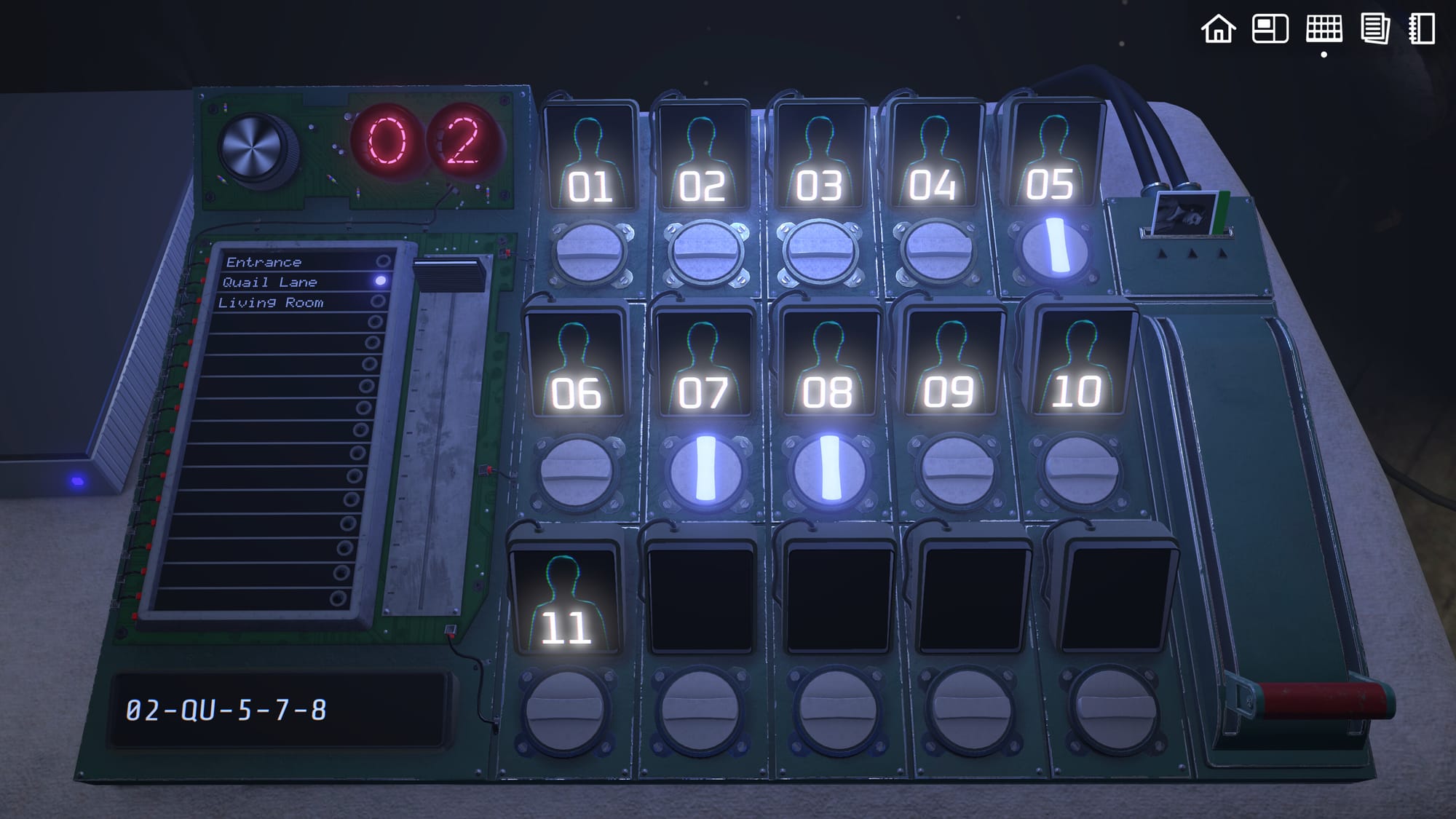
But the gameplay itself in Galley House diverges a lot from the aforementioned games. We're not filling in people's fates to get them verified anymore, instead we use a mysterious machine that allows us to look into the past, to catch glimpses of voices, similar to Unheard, and movements of silhouetted figures, similar to Tacoma, to uncover what happened in an abandoned house years ago. The puzzle element itself is figuring out how to find the next bit of the stories being told by inputting who was where and when.
What strikes me, though, when looking back at these games is that what makes these click so well for me is the way they make me feel like a detective instead of just controlling one. Sure, I enjoy Frogwares games about Sherlock Holmes, especially Crimes and Punishments, but I am distinctly just controlling Sherlock as he solves the mystery. Not I.
It is as if these games believe in me. Believe that the player is able to figure things out for themselves. And it is a testament to the quality of these games that they are able to make it possible for us to follow through with the investigation. They could make it too hard, such as Her Story, where players eventually give up because they can't think of more search terms and the story peters out, or too easy so you're just putting the square in the square hole like Ace Attorney and watch as the game solves the case for you.
Which is exactly where Obra Dinn, Roottrees and Galley House excel, because they know that things can get too hard, and that sometimes the player needs help. In Obra Dinn, the locations of a select few corpses are revealed to you, and each person has a dynamic "deduction rating" associated with them that tells us how easy it should be for us to figure their identities out. Both Roottrees and Galley House have something similar in the form of an intuition count, a number that tells us how many associated clues or scenes can be found from any other clue or scene. However, the games by Evil Trout go one step further by implementing a robust hint system.
Both of his games use tiered hint systems that start as gentle nudges and escalate toward an outright answer if you keep asking, with no penalty either way. While the hint system is rarely talked about, and almost never shows up in any Let's plays of puzzle games, puzzle gamers being the masochists they are who want to bang their heads on a wall for hours rather than admit they need a small nudge, I believe it is one of the things that set the notebook mystery games apart. They hand us a mess and trust us to make sense of it ourselves, but they don't punish us if we need that little push to continue.
I might not have gotten any writing done on Thursday, but unraveling the mystery of the Galley House was well worth the time.
-- Amir