Train Dreams and Why I Can't Write Just for Myself
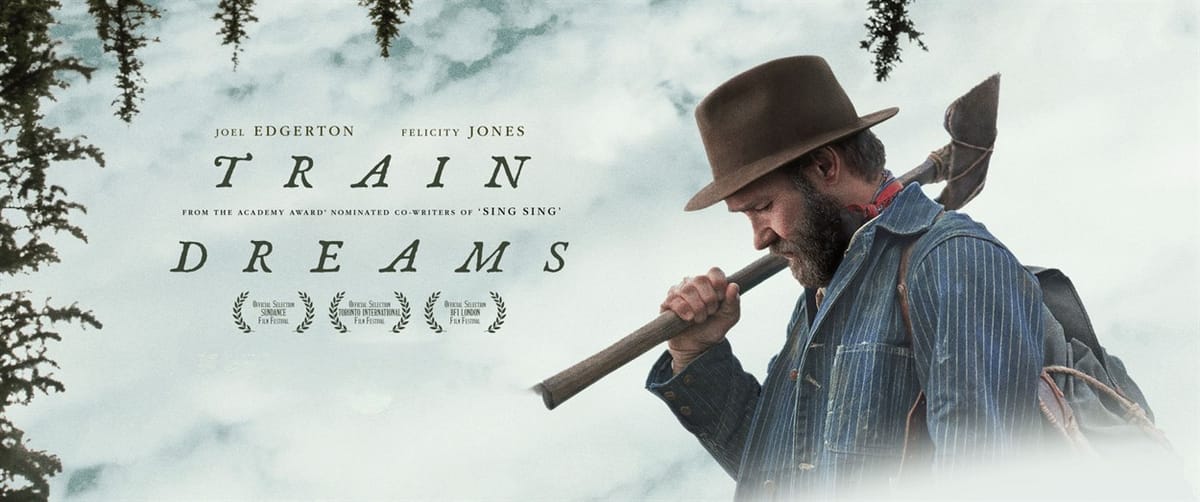
I watched Train Dreams a while back and absolutely loved it. It's been lingering at the back of my mind ever since, and every now and then it creeps up to the front. There was something about this movie that really resonated with me. The movie is based on the Denis Johnson novella with the same name, and is about the life of a man named Robert Grainier, a life you might call a failure.
Grainier worked hard his whole life. Spending days upon days in the woods laying railway tracks. He established a family, but spent weeks away from them earning a living, only to one day return home to discover them lost after a brutal forest fire. He grieved for a long time and never reconnected with humanity. He simply kept going, with no goals or ambitions, just earning enough to go on living. And then, when his life came to an end, no one noticed. He lived without making any big ripples, and died alone, remembered by no one. It is almost as if his entire life did not matter at all. Does that mean his life was pointless?
This train of thought reminds me of an idea I first came across when reading The Courage to be Disliked, a philosophy book written by two Japanese philosophers, Ichiro Kishimi and Fumitake Koga, drawing on the work of Alfred Adler, a contemporary of Freud. I have complicated feelings about the book over-all, some things I really liked, other things I find questionable. I will probably write about it properly another time. But one idea in it has stayed with me: The Courage to be Normal.
It is the idea that you don't need to be special, or live an exceptional life, to have value. We are driven by a need to achieve something, to be recognized and leave something behind, driven by a fear that to be ordinary, normal, is to lead a lesser life. A life that is worthless. So we push ourselves to stand out, constantly striving to prove that we matter, and worst of all: to constantly compare ourselves to everyone else.
Letting go of this exhausting need is the core of this philosophy. It means accepting that you can live a completely ordinary life, like most lives have been for the vast majority of humanity, without any grand accomplishments to your name, and recognizing that as a worthwhile life. When you stop trying so desperately to validate your existence and untangling your self-worth from the need to be extraordinary, you can finally relax and maybe discover meaning in the simple, everyday moments of life. This is not easy. That's why they say it takes courage. Courage to accept that it is fine to be normal.
I read this book years ago, and I could do nothing but agree. Wholeheartedly. All lives matter, no matter how plain it is lived. But… I seem unable to accept it for myself. The thought of just being normal, average, creates a knot of dread in my stomach. I want to be special. I need to be special.
I enjoy writing. I find it fun. I have so many ideas, so many stories inside me that yearn to be written down. I could just leave it at that. Write them down, put them in a drawer, and move on to the next story. Just because I write does not mean I have to publish them. Like people who paint and have no interest in galleries, or people who play instruments and perform only for themselves or family and friends. They do it because they love it, because the making of the thing is the whole point, and the idea of turning it into something for public consumption has never appealed to them. But I cannot settle for that. Or rather, I have never been able to convince myself to be happy with that.
When I ask myself why, I am unable to come up with a satisfying answer. Maybe I just want to leave something behind. Not fame, exactly. I am not sure I actually want to be famous. But I want there to be evidence. Some trace that I was here and that I will be remembered. It might be tied to a fear of death: by ensuring I am remembered, the memory of me lives on.
Robert Grainier did not leave anything behind. No one would ever remember him. His work laying railroad tracks had either been replaced by highways or by newer, better train tracks by the time he died. He did play a part in something bigger at least, but there was nothing that said "Robert was here" when his life was over.
And I believe the film suggests that this is fine. That this was a life, and it was a complete life even if no one remembered it. His unremarkable life certainly made for a great movie, one that keeps being present at the back of my mind.
I think the film is right. I think “The Courage to be Normal” is healthy, and if you can accept it, you’re more likely to find happiness. I just find myself unable to accept it for myself, and I am not sure why. Is it ambition, ego, or fear, or some combination of all three?
My lack of courage to be normal is one part of what drives me to be a published author, but not the sole reason. I believe I have good stories in me that maybe one day can resonate with people like Train Dreams did for me. In the meantime, I plan to continue being honest about both my achievements and failings. I hope that resonates with someone.
--Amir